


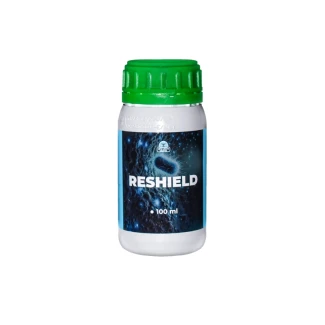
ReShield: Microbial Insect Control for Leaf and Soil
Insect problems rarely come alone. Shake a plant and a cloud of whitefly lifts off. Check the substrate and there are larvae. Look under the leaves and thrips are already there. Different targets, different stages, different environments.
Microbial insect control built around a single mechanism covers part of that picture and leaves the rest open. ReShield starts from the opposite idea, holding the canopy and the growing medium at the same time.
The result is a broad spectrum shield, though it comes with usage rules that decide whether it actually works.
Different insects, different hiding places
Many insects alternate between stages that unfold in separate environments. Adults fly and feed on foliage, while eggs and larvae mature in the substrate or in the plant's most sheltered zones.
Treat only the canopy and you leave intact the reserve that repopulates the crop days later. Treat only the medium and the egg laying adults carry on undisturbed. This is why ReShield includes both routes and does not present them as alternatives.
What ReShield contains
The formulation combines mycorrhizae at 1 per cent, six bacterial strains at 3×10⁹ CFU per gram and additional rhizosphere bacteria at the same concentration of 3×10⁹ CFU per gram.
It is a consortium rather than a single active ingredient, and that is its defining feature. Different strains work on different targets and different microenvironments, which explains the wider spectrum compared with a product built around one microorganism.
Here too the microorganisms arrive as viable dormant spores, activating on contact with water, oxygen and surfaces worth colonising.
How entomopathogenic fungi work

Beauveria and Metarhizium rank among the most studied entomopathogenic fungi and their infection route is documented in detail. The spore attaches to the insect surface, germinates and produces extracellular enzymes.
Proteases, lipases and chitinases do the decisive work, degrading cuticle components and allowing penetration. Once past the outer barrier the fungus colonises the host from within.
That enzymatic toolkit is the interesting part. It handles thick cuticles as well, so the action is not limited to soft bodied insects and reaches tougher targets such as beetles.
Which insects it targets

The product suits situations involving whitefly, thrips and beetles, along with leaf feeding insects in general. On the soil side it covers soil dwelling pests and fungus gnats, usually the least visible and most persistent part of the problem.
That breadth makes it useful when a crop hosts several targets at once, or when you are not certain what you are dealing with. In those cases a narrowly targeted product works one front while the others stay active.
What the rhizosphere bacteria add

The bacterial component does more than hit insects. Competing with pathogens in the root zone improves the microbiological fertility of the substrate and stimulates root development, creating an active biological barrier.
Mycorrhizae complete the picture by amplifying the absorbing surface and supporting the plant through stress. A plant that handles difficult conditions better is also a less attractive plant for whatever wants to attack it.
Rates and intervals

Foliar application ranges from 1 to 1.5 ml per litre, repeated every 10 to 15 days. Root application moves up to a range between 1.5 and 2.5 ml per litre in fertigation.
The dosage window is not arbitrary. Staying at the lower end suits preventive management, while moving up makes sense when insect pressure is high or the substrate is already compromised.
Preparation matches the rest of the line. Shake the bottle, dissolve in non chlorinated water, wait at least fifteen minutes while stirring occasionally, then shake again before use.
The most common mistakes
Treating only where the problem is visible comes first. If an insect has a stage in the growing medium, foliar work alone produces temporary relief followed by a punctual return.
Then there is chlorinated water, which cuts spore viability before anything reaches the plant, and haste during preparation. Finally there is incomplete foliar coverage, which on a contact based product carries as much weight as the choice of product itself.
What ReShield does
ReShield is a broad spectrum microbial consortium for leaf and soil insects, including whitefly, thrips, beetles and fungus gnats. Spores attach to the insect and degrade its cuticle through lytic enzymes. Apply at 1 to 1.5 ml per litre as a foliar spray and at 1.5 to 2.5 ml per litre in fertigation.
Frequently asked questions
ReShield or ReStrike?
It depends on the target. ReStrike leans towards soft bodied insects and early infestations, while ReShield covers a wider spectrum that includes harder cuticles and soil linked problems.
Can it be used preventively?
Yes, and that is where it pays off most. Applying at regular intervals maintains constant biological pressure, which beats intervening once a population has already exploded.
Does it work in pots and in open field?
Both application routes function in either context. What changes is the volume of solution required and the logistics of distribution, not the principle behind the product.
Available sizes
ReShield comes in 100 ml and 1 litre formats. Given the dual application route, anyone running a full protocol across foliage and substrate uses more product than someone treating a single front, and the larger format quickly becomes the sensible choice.
The underlying logic matches the whole line. Not a sharp blow once damage shows, but a stable microbial presence that makes the crop a less welcoming place for anything looking to settle in.


